Showing posts with label Hinduism. Show all posts

Friday, December 29, 2017

Islamophobia & a Challenge to Bill Maher - Deepa Kumar on RAI (Part 1/5)

A great series of interviews with Deepa Kumar. She puts the right perspective on how US has always been interfering with the development & politics of developing countries, especially, Islamic countries. The whole interview can easily be summarized in the last line of interview, "the people of the Middle East and North Africa are just like everybody else. They want economic rights. They want political rights and so on. And if the U.S. just stopped interfering, we would see a flowering of a different kind of society."
Islamophobia is perpetuating lies that Islam is a backward religion because it doesn't give rights, for instance, to women. However, the problems of giving or not giving rights to women is more a cultural / political one than religious one. As Ms. Kumar says that by merely focusing on these topics & then equating these "to a problem of Islam as opposed to a problem of politics" perpetuate the notion that "all Muslims are backward, which is the very essence of Islamophobia."
Then, fundamentalism exists in every religion, & heck, even in atheism. Atheists are some of the most fundamentalist people in this world. Every religion has its die-hard followers; there are fundamentalist Muslims, Jews, Christians, Hindus, Buddhist etc. We can see how fundamentalist Buddhist killed, & still killing, poor Rohingya Muslims in Myanmar. We can see how die-hard Hindus (BJP is a very fundamentalist Hindu political party) killing Muslims in India over the issue of beef. Fundamentalist Christians / right wing militias roam free in US & have killed ethnic & racial minorities (African-Americans, South Asians etc.). Their actions are not attributed to their religions & no one asks other non-fundamentalist Christians, Buddhist or Hindus to absolve / distance themselves from the actions of their fundamentalist brethren in religion.
One thing which Paul Jay refers to, which I would really like to highlight is that how the whole world has been focusing on the barbarism of ISIS in Iraq & Syria. What about the barbarism of US when it dropped atomic bombs on Hiroshima & Nagasaki, when, as the details are coming forth now, that they were not even needed to end WW2. If one starts to scrutinize American actions all over the world, we see that barbarism of ISIS is nothing compared to what America has done all over the world.
Now, the negative stereotypes of Muslims & Islam has been around since the birth of Islam in 600 AD. They have been perpetuating these stereotypes since the Crusades when the Pope wanted to unite all Christians under the flag of Crusades & paint all Muslims as one evil group of people who have been worshipping the bad or wrong God. The sad & unfortunate part is that even Muslims now are starting to believe in these stereotypes & think that Islam is the main reason which has been keeping Muslims & Muslim societies from developing. US & its Western allies also have their hands in this that they don't want Islamic societies to develop.
Islamic societies / countries have always been ready to develop (while living within the boundaries created by Quran & Prophet's tradition), either scientifically, politically, culturally, but alien forces (US & other Western powers) have always interfered in that development. The West / Global North want dictatorships in Middle East because it serves their own purpose. So, blaming the religion of Islam or thinking that Muslims are so backward in their thoughts that this is all they can come up with, is completely wrong. At the end of the day, a Muslim anywhere in the world is just like anyone else; he / she wants to live peacefully, enjoy his / her life here, peacefully earn a living, & then die a satisfied / happy person.
-----------------------------------------------------------------------------

PAUL JAY, SENIOR EDITOR, TRNN: So what's wrong with what Bill Maher said? Bill Maher is saying that there's a great denial of rights in much of the Muslim world, not just Islamic State, but Saudi Arabia and so on, and there isn't a lot of loud critique about it. And certainly the American left spends a lot more time critiquing the domestic right. So doesn't he have a point?
DEEPA KUMAR, ASSOC. PROF. MEDIA STUDIES AND MIDEAST STUDIES, RUTGERS UNIV.: Well, what Bill Maher said is a perfect example of what I call liberal Islamophobia, which is to take up liberal themes, such as human rights, women's rights, the rights of gays and lesbians, the right to free speech, and so on and makes a case of the so-called Muslim world, like it is one big monolith in which these rights are uniformly denied to people, and then proceeds to equate, in essence, the politics of ISIS with the politics of the 1.5 billion people who practice Islam, when in fact you actually look at Muslim majority countries, which is the term that I prefer, they vary widely in terms of, for instance, the status of women. In Bangladesh, for instance, we've had two women heads of state voted into power, Khaleda Zia and Sheikh Hasina. But in Saudi Arabia, women aren't allowed to drive.
And so of course there are these kinds of examples from Muslim majority countries like Saudi Arabia, like Iran, where women's rights are restricted. But by focusing just on those and somehow equating this to a problem of Islam as opposed to a problem of politics, he winds up perpetuating this notion that all Muslims are backward, which is the very essence of Islamophobia.
JAY: He does something else, too. He ascribes, essentially, fundamentalism about the Quran, and then all believers in Islam are somehow also fundamentalists.
KUMAR: Right.
JAY: But he doesn't do that for Christianity, because there's just as much craziness in the Bible as there is in the Quran, I think. ...
KUMAR: No, you know, any religious text, whether it's the Quran or the Bible and so on, can be interpreted in multiple ways. There are progressive interpretations of it and then there are reactionary interpretations of it. ...
Imagine if for every act of terror committed by a Christian fundamentalist, a far-right militia person like Wade Michael Page, who went to Oak Creek, Wisconsin, and shot a gun at a Sikh temple and killed people and so on, now imagine if we were to generalize from Wade Michael Page to all of Christiandom, to all of the United States, and say, now everybody else should denounce this man and distance themselves from him; otherwise, you're all culpable. Now, that's completely ridiculous, and of course that would be ridiculous if we talk about Christians in the West, but apparently it's completely acceptable when it comes to talking about Muslims. And so even President Obama said moderate Muslims should separate themselves from ISIS and from other groups and so on. Why? In what way, shape, or form are regular Muslims responsible for fundamentalism any more than regular Christians are responsible for Christian fundamentalism or regular Jews for Jewish fundamentalists? You get the idea. We see those people as being the extreme wing of a particular religious interpretation.
...
JAY: ... There is nothing the Islamic State has done that compares to the barbaric activity that the United States has done in Iraq and on and on, going right back to the atomic bombing of Japan. So if we're talking scale here, the Islamic State is a whisper of what the United States has done.
That being said, one does not need to hold back on describing IS as a barbaric, brutal force that the people of the region on the whole, you would think, will despise, just as much as most Afghans despise the Taliban.
KUMAR: Absolutely. I completely agree with that. ... in my book, actually, I have a pretty strong critique of the parties of political Islam, and I don't think we should be soft on that. There was a tendency back in the 1970s, when Foucault goes to Iran and so on, to see--particularly in France there was a tendency to somehow see the Islamists as being progressive and painting with progressive colors the Iranian Revolution and so forth. But I don't think that tendency exists anymore. I think, if anything, one of the first few pieces that I wrote on this topic is about the left and their attitudes towards political Islam, is how ignorant the left was in terms of, actually, Islamophobia and in terms of sort of equating the Islamists with all of Islam and all of Muslims and so forth. So I think that there is, in the United States especially, a sort of blind spot around Islamophobia and a lack of a nuanced analysis of who these groups are, why they come to power, and what the historic conditions are for their rise.
JAY: It seems to me where he is--one is this part of where he extends this to anyone who believes in Islam and tries to make Islam itself and come up with some quotes from the Quran that are particularly backward is one thing. But the second thing, which is this idea that he talks about our society having liberal values and free speech and this and that, you can argue what that's becoming and with this national surveillance state and so on, but it's still true. I mean, compared to a lot of societies, ... we can have this conversation, and we're not going to walk out and get arrested.
That being said, it's at home you have those things. The United States has 50, 60 years of supporting the worst kind of dictatorships everywhere, and particularly in the Middle East, whether it's supporting the Saudis and so on and so on. There's no support for these kind of values when it conflicts with American interests abroad.
KUMAR: Right. ... the narrative that gets constructed in the West and that Bill Maher and people like that are echoing is the clash of civilizations rhetoric, which was coined by Bernard Lewis and then popularized by Samuel Huntington, which is the idea that in the post-Cold War period, conflict would no longer be political, it will be cultural, and that there were seven or eight civilizations, each with their own unique cultures--the West and the Islamic world and so on--and that they are bound to conflict with each other.
... there are any number of problems. It's ahistorical, it's just wrong, and so on. But the problem I have with it, one problem, at least, is that it negates the fact that the rights that people do have in this country, whether you're talking about workers' rights, the rights of African Americans to vote, the right of women to vote, this didn't happen automatically because some benevolent president decided. It's people's movements, it's women fighting for 100 years and their male allies that caused suffrage, right? And, therefore, somehow to assume the liberal mantle as being the natural inheritance of what it means to be the West, starting from Greece to the present, and seeing the East, particularly Muslim majority countries, as being mired in barbarism, this is the classic language of colonialism, which whether Bill Maher knows it or not, that is what he's echoing. And, in fact, even in the East, in Iran, in Egypt, you've had Feminist movements, you've had women's rights movements, which we barely ever hear of.
JAY: Well, the roots of this go right back to the early days of the Catholic Church and the fighting against--the Crusades, and then the Ottoman Empire. I mean, it wasn't about liberal values then. It was about the true god, and they got the bad god, and we're going to fight it out. But it's kind of--the roots of it go very deep.
KUMAR: Absolutely, which is why my book is called Islamophobia and the Politics of Empire and it starts with the Crusades, because every empire needs an enemy. And at least one of the motivations for the Crusades was to create this ideal Muslim enemy, which could then motivate people to go out and fight wars. But it was always--there was always a very contradictory notion of how to look at the East, because even while the Crusades are going on, you have the most horrific stereotypes of Muslims and all the rest of it.
In al-Andalus, which is the name given to Muslim rule in the Iberian Peninsula--Spain and Portugal--you see the most advanced civilization. Remember, Europe is in the dark ages at this time, right, and here in al-Andalus you have street lighting, you have developments in science, medicine, and so on. In that region, Europeans had a very positive idea of Muslims and what they developed because they had actual contact with them. So, typically this idea of a Muslim enemy works when people have never met anybody from the Middle East or North Africa or have never traveled. And then the stereotypes can work, just as it's working in the case of ISIS and scaring people to death.
JAY: But I think one of the things that always gets missed in this conversation in the mainstream media is that these are class societies we're talking about, the Muslim societies, Arab societies. And in many of them, the classes that are in power are barbaric and they are backward and they do call up the worst of whatever you can call up in Islam, the same way you can find in Christian fanatical regimes in Latin America and other times.
KUMAR: Absolutely.
...
JAY: I think part of it is ... like, if you're in any of the Muslim countries and you see what American policy in the Middle East has been, you are going to--unless you're in the elite and you somehow benefit from it, but even amongst the elites I think there's going to be resentment ... . The thing is: what else is there to have some sympathy for than the Islamist opposition? Why? Because the American policy and the Israeli policy destroyed the secular opposition.
KUMAR: That's right. And this has been happening through the course of the Cold War, when it was clear that the secular nationalists, whether you're talking about Gamal Abdel Nasser in Egypt or you're talking about Mohammad Mosaddegh in Iran, when it was discovered that they couldn't be co-opted to serve the U.S.'s interests in the region, the key policy from 1958 on with the Eisenhower doctrine was to create an Islamic bulwark to act as a counter to secular nationalism. And you read some of the accounts of what the CIA is doing, and they're putting poison into Nasser's cigarettes, they're trying to put poison into his chocolates, some of these sorts of awful things that you think happen only in the movies. But at a very systemic level what they're doing is funding and sponsoring all sorts of radical Islamist groups, all the way from Iran and across the region.
JAY: Well, and most importantly it starts with Roosevelt, the deal with the Sauds. I mean, the Saudis are the heart of all of this. And this was the deal, that the Saudis would use the defense of Mecca to be the force to spread Wahhabism throughout the region, and all this extremism is part of American policy.
KUMAR: Absolutely. In fact, the language that they used in the State Department is that they wanted the Saudi monarch to be an Islamic Pope and to use the legitimacy of being the guardians of Mecca and Medina to actually push people away from secularism. So absolutely. And Saudi Arabia had a very systematic program of Islamization, whether it was distributing Qurans for free, whether it was giving tons of petrodollars for setting up madrasas all over. Not just in the Middle East, but even in Pakistan they set up schools and colleges and send their preachers there and so forth. And the end result is the mujahideen, is al-Qaeda.
And, I mean, I think that's really important to bring up, because there's a tendency to somehow think of the parties of political Islam as being the sort of logical outcome of this region -- this is all that Muslims can produce. But if you don't talk about how left secular alternatives were systematically crushed by the U.S., by Saudi Arabia, by Israel, and so on, then you don't get a sense that these are people just like anybody else who have a range of politics.
JAY: And not only left-secular; they destroyed in Afghanistan a more normal capitalist development. They had a king that was a modernizer. They wanted to have a more modern capitalism. And they threw it all out the window to suck Russia into a war and then arming all the jihadists and, village elders who didn't know anything, give them rocket launchers, and they become the new powerbrokers. And then you wonder where the Taliban comes from.
KUMAR: Right. In fact, every single reformist and pro-democratic movement that has come into being in the Middle East and North Africa, the U.S. has always been on the wrong side of it, even in Saudi Arabia. There was a modest movement called the Free Princes Movement, where they wanted a constitutional monarchy. Would the U.S. have any of it? Absolutely not. They immediately dispatched forces to make sure these forces are marginalized. There was a workers movement in the Shia eastern region trying to form unions, but Aramco, at that time American-owned, would have none of it. And so they got rid of that. So every step towards creating rights for a whole group of people, from workers to women and so on and so forth, the U.S. is always been on the wrong side, including after the Arab Spring of 2011, right? So you look at the role that the U.S. is played: support the dictators till the very last second, and then back to counterrevolutionaries, whether it's Egypt and the military or it's giving the green light to Saudi Arabia to crush the resistance in Bahrain, what have you.
And so I think that framework is important, because then you start to see that the people of the Middle East and North Africa are just like everybody else. They want economic rights. They want political rights and so on. And if the U.S. just stopped interfering, we would see a flowering of a different kind of society.

Tuesday, September 1, 2015

City in the sky: world's biggest hotel to open in Mecca

I think if Prophet Muhammad (Peace be upon him) come back to life now & go to Mecca, he wouldn't be able to recognize his own city, & more than likely, he would cry on what the keepers of the Two Holy Mosques have done to such a sacred city. I'm not even going to discuss how he would feel at the status of Muslims around the world.

As the article states, Mecca has become the "Las Vegas for pilgrims." In the article, some one else calls Mecca, the "Mecca-hattan." Really? Will this make Muslims happy that one of the two sacred cities for them is being compared with the "Sin City" & Manhattan?

No, it's not the fault of the writer to compare Mecca with Vegas. I's the fault & greed of the Saudi Royalty who have built so much secular / worldly grandiose monstrosity around the "House of Allah" that it is definitely a miracle that one can even see that sacred House from the air (even that, if you are hovering directly above it).

On top of that, as the article points out, that with these monstrous & very expensive developments, akin to Dubai, Abu Dhabi, & Doha, the poor residents & pilgrims are slowly being priced out of the city. It's like a gradual gentrification where rich elites are trying to get rid of the poor from Mecca by making the real estate in it so expensive that poor people can't visit or live in the city. Just like the poor people in Dubai, Abu Dhabi, & Doha live far outside of the city center, since they can't afford the luxurious lifestyle of the people (who are usually European & North American expatriates) who actually live in the city center.

Ironically, the lifestyle of the Prophet, whom the Saudi Royalty, Saudis, & the whole Muslim world purport to love & follow his ways, was, essentially, of a modern-day poor man. He could count his assets on his fingers. But his followers, in this day & age, apparently count their blessings & show off that wealth by staying at 5-star hotels, like InterContinentals & Hiltons during their pilgrimages.

I am blaming those Muslims (non-Saudis & commoners) because those Muslims are creating demands for these kinds of monstrosities. I mean how can these Muslims feel the hardships & learn from the pilgrimage when they stay in these 5-star hotels with all the luxuries, & perhaps, more luxuries than their own homes. That's why, several Muslims proudly boast that they have performed pilgrimages multiple times, even though, the cost of each pilgrimage is becoming astronomical. Because, pilgrimage for these Muslims is like a walk in the park.

Yes, I agree that in Wahhabism or in true Islam, old sacred sites should be torn down because they do give rise to idolatory. Heck, even now, when Muslims visit Medina, some Muslims start praying to Prophet like, Allah forbid, he is their god. So, destroying non-religious sites is one way to not encourage idolatory but building Paris Hilton stores & Starbucks in their places is also very wrong.

Just imagine, if this same Royalty would've spent this wealth in helping Muslim refugees in Iraq, Syria, Burma, then those Muslims wouldn't have to find shelters in non-Muslim European & South-East Asian countries. Heck, if all those rich Muslim pilgrims who stay in these ultra-pricey hotels during their pilgrimage spend that money on helping their poor brothers & sisters in Islam, they would earn more rewards than showing up in Mecca to show off their social status by booking hotel rooms in these monstrosity of hotels.

If you are still thinking that all these gaudy construction is all well & good, then ask yourself these questions:

1. How many big multibillion $$$ hotels have been, or are being constructed, around the Wailing Wall in Jerusalem? (Judaism holy site for pilgrimage)
2. How many big multibillion $$$ hotels have been, or are being constructed, around the churches in Christianity's Holy Land? (Christianity's holy sites for pilgrimage in Jerusalem)
3. How many sacred pilgrimage sites of Hinduism, Sikhism, or Buddhism are being overshadowed by monster hotels right beside them? (a quick Google search will help you know the answer).

So, why do Muslims, whose Prophet preached to let go of the world & its wealth, are the ones to not only build such buildings & desecrate their holy sites by physically making them so small & miniscule (generally, us, people don't like small things in this world), but also enthusiastically create demand, by shelling out thousands of their money, for someone to build such things?
---------------------------------------------------------------------------------


4 helipads will cluster around one of the largest domes in the world, like sideplates awaiting the unveiling of a momentous main course, which will be jacked up 45 storeys into the sky above the deserts of Mecca. It is the crowning feature of the holy city’s crowning glory, the superlative summit of what will be the world’s largest hotel when it opens in 2017.

With 10,000 bedrooms & 70 restaurants, plus 5 floors for the sole use of the Saudi royal family, the £2.3bn Abraj Kudai is an entire city of five-star luxury, catering to the increasingly high expectations of well-heeled pilgrims from the Gulf.

Modelled on a “traditional desert fortress”, seemingly filtered through the eyes of a Disneyland imagineer with classical pretensions, the steroidal scheme comprises 12 towers teetering on top of a 10-storey podium, which houses a bus station, shopping mall, food courts, conference centre & a lavishly appointed ballroom.

Located in the Manafia district, just over a mile south of the Grand Mosque, the complex is funded by the Saudi Ministry of Finance & designed by the Dar Al-Handasah group, a 7,000-strong global construction conglomerate that turns its hand to everything from designing cities in Kazakhstan to airports in Dubai. For the Abraj Kudai, it has followed the wedding-cake pastiche style of the city’s recent hotel boom: cornice is piled upon cornice, with fluted pink pilasters framing blue-mirrored windows, some arched with a vaguely Ottoman air. The towers seem to be packed so closely together that guests will be able to enjoy views into each other’s rooms.

The city is turning into Mecca-hattan,” says Irfan Al-Alawi, director of the UK-based Islamic Heritage Research Foundation, which campaigns to try to save what little heritage is left in Saudi Arabia’s holy cities. “Everything has been swept away to make way for the incessant march of luxury hotels, which are destroying the sanctity of the place & pricing normal pilgrims out.”

The Grand Mosque is now loomed over by the second tallest building in the world, the Abraj al-Bait clocktower, home to thousands more luxury hotel rooms, where rates can reach £4,000 a night for suites with the best views of the Kaaba – the black cube at the centre of the mosque around which Muslims must walk. The hotel rises 600m (2,000ft) into the air, projecting a dazzling green laser-show by night, on a site where an Ottoman fortress once stood – razed for development, along with the hill on which it sat.

The list of heritage crimes goes on, driven by state-endorsed Wahhabism, the hardline interpretation of Islam that perceives historical sites as encouraging sinful idolatry ... . In Mecca & Medina, meanwhile, anything that relates to the prophet could be in the bulldozer’s sights. The house of Khadijah, his first wife, was crushed to make way for public lavatories; the house of his companion Abu Bakr is now the site of a Hilton hotel; his grandson’s house was flattened by the king’s palace. Moments from these sites now stands a Paris Hilton store & a gender-segregated Starbucks.

These are the last days of Mecca,” says Alawi. “The pilgrimage is supposed to be a spartan, simple rite of passage, but it has turned into an experience closer to Las Vegas, which most pilgrims simply can’t afford.”

The city receives around 2 million pilgrims for the annual Hajj, but during the rest of the year more than 20 million visit the city, which has become a popular place for weddings & conferences, bringing in annual tourism revenue of around £6bn. The skyline bristles with cranes, summoning thickets of hotel towers to accommodate the influx. Along the western edge of the city the Jabal Omar development now rises, a sprawling complex that will eventually accommodate 100,000 people in 26 luxury hotels – sitting on another gargantuan plinth of 4,000 shops & 500 restaurants, along with its own six-storey prayer hall.

The Grand Mosque, meanwhile, is undergoing a £40bn expansion to double the capacity of its prayer halls – from 3 million worshippers currently to nearly 7 million by 2040. Planned like a vast triangular slice of cake, the extension goes so far back that most worshippers won’t even be able to see the Kaaba.

It is just like an airport terminal,” says Alawi. “People have been finding they’re praying in the wrong direction because they simply don’t know which way the mosque is any more. It has made a farce of the whole place.”

Thursday, June 18, 2015

Confessions of a failing Catholic

A good opinion piece. This is one of the main reasons why Catholic Churches in Europe & North America are sitting empty, while other religions are thriving. Although, there are some different reasons for other religions increasing their numbers, the main reason is the community support, which in itself is done through the leadership.

Most psychologists agree that humans have an innate desire to follow a supreme being. And in following that, they look towards the supporters & leaders of that religion. Most do it through an organized religion but some also do it on their own. I'm not judging here, who is right or wrong.

But when leaders themselves are not principled, their actions don't follow what they preach. People are not stupid enough to not see that. When they see their religious leaders not doing what they preach, they start to lose their own faith, which, in turn, adversely affects the perception of the whole religion.

This is also happening in other religions, albeit more slowly than the Catholic Church. Money is the new religion, which requires no rules & restrictions. No morals or ethics are required in this new "religion". Religious leaders are losing their principles (assuming they had principles in the first place) & people losing interests in their religion & faith.

Seeing the corruption of their "childhood" religions, some people start to look elsewhere & convert. However, that's a very involved & soul-searching process, & not everyone wants to mentally tire themselves in finding out the meaning of life. Sometimes, those people who convert start to see the corruption of their newfound faith, & then they move again or they lose interest in organized religion at all.

At the end of the day, religious leaders need to be principled & do what they say. If they believe that they can't uphold the principles & values of the religion they are preaching, then they should resign themselves from their posts, so they don't spread their own corruption into the community. Leadership is a very responsible post; be it of any organization, secular or religious. Leaders need to keep in mind that the eyes of the whole community are on them. If they slip up, then it will adversely affect the whole community.

A strong sense of community is very much in demand in today's world, & people will flock to that organized religion which offers them that sense of community, the most. They may even join a cult just for that community feel. So, religious leaders have to correct their compass & be steadfast on it, because, if they lose their compass, the whole community starts to go astray.
---------------------------------------------------------------------------------


I’ve had bad luck with my priests.

The first one was Father Albert, a warm, charismatic & eloquent man who figures prominently in my childhood memories. He was almost a member of our family. But then one day he disappeared without explanation.

Father Albert was replaced by a young, bearded, barrel-chested priest who played bass guitar. I once saw him throw a football 60 yards. Then he also departed in a hurry. We heard later he’d been sleeping with a woman in his band.

In my twenties, my priest was earnest & awkward, with an off-kilter wit. I didn’t get to know him very well before he, too, fell in love with a woman in the parish, someone who he had been counseling. The Church sent him away quickly.
 
Father Joe, my last priest, was a friendly man who disarmed everyone with his maritime accent & humorous sermons. As far as I know, he never started a romantic relationship with anyone. Instead, he went to jail for stealing several hundred thousand dollars from the parishioners.
 
You would think with spiritual mentors like that I would walk away. I did, for a few years after college. It wasn’t a conscious decision of humanist rebellion. I was simply busy. Sundays came & went, & there were far too many things to distract me.
 
In my thirties I moved to a new city & found a tall stone church down the street. The nave was cool in the summer heat, & colourfully lit by soaring stained-glass windows. The oak pews were dark with age & worn smooth by generations of use. I felt at home, & began to attend mass again, albeit irregularly.
 
But I’m not a natural joiner & always sat at the very back. I was raised a Catholic, attended Catholic schools, & even have priests in the extended family. But I am only comfortable attending mass if I am near the door, to reassure myself I am merely stopping in, & can leave at any time. And I have. Not long ago a guest priest began to explain how families were being torn apart by the professional aspirations of women. I gathered up my 2 daughters & we went for ice cream.
 
But my problems with Catholicism go well beyond the occasional fatuous sermon. The Church’s treatment of women remains medieval. Its discrimination against gays & lesbians would be considered criminal were it any type of secular organization. And even though 39 million have died from HIV/AIDS, Rome still fights to restrict access to condoms. If the Pope had given each of those people Last Rites, one after the other day & night, it would have taken him over 30 years.
 
I also have struggled hard with my faith itself. As a child I listened to the Book of Genesis with a skeptical ear. Growing older, I struggled with the idea that even the most virtuous non-believers (like my father) would go to hell. Later I tried & failed to reconcile the concept of free will with God’s will. I have never understood why the Supreme Being, ruling over the entire universe, would smite me unless I flattered him with rote prayers. And the few times I have found myself in extremis, it wasn’t Christ who came to mind; it was thoughts of my parents, or in later years my children.
 
I am technically a heretic but I still call myself a Catholic. My ethical compass, wavering though it may be, is clearly Augustinian. I still go to mass. I still sit in the back. I close my eyes & listen to the hymns & feel the sun on my face as it filters through the great windows. My church, though, is steadily emptying. Obviously, Father Joe’s arrest cleared out many of the pews. But across the country, attendance has declined while atheism has risen. Only one of my friends attends a weekly service with any regularity. I go less & less, myself. But I still go.
 
For me, church is not about my faith; it is about my community. I never linger for the bake sales & I can’t tell you the name of the new priest (my history suggests he won’t be around very long anyways). I don’t even know any of the other parishioners by name. But I recognize most of their faces, & from my vantage point in the last pew all of their backs. And that is a profound comfort.
 
My life is lived by email & phone call. My friends are dispersed, my family spread far & wide. My relationships are mostly virtual, kept alive by text messages & Christmas cards. Like most of us, I am connected to thousands, but honestly know only a few. Even though we never speak, the sight of the familiar strangers in church gives me a physical sense of community, of tangible belonging.
 
For millennia, humans were born, lived & died within the same few miles. They did not know very many people, but they knew them well. Their sense of identity was less about who they were than where they belonged. Then, in the span of a few generations, this all changed. We began to travel, to disburse, to bond with TV characters, to create online networks, to disappear into our inboxes. At the moment when we have never been more isolated & more in need of a real community, the Church has failed to provide it. It is perhaps one of the great ironies of our age. Archaic doctrine. Repressive rules. Institutionalized bigotry. Abuse scandals. Unapologetic bishops. It was almost as though Rome was trying to alienate us.
 
After drafting this column, I decided to find out what happened to Father Albert, the smiling man who gave me my first communion & then vanished. A couple of calls informed me that he’s gravely ill, apparently, in an old age home. And, while it took 20 years, he is now facing charges for sexual assault & gross indecency. They are not sure if he will live to see his trial date later this year.

Saturday, May 16, 2015

Life of Pi (Quote 4)

Spoiler alert: Pi is a raised in a predominantly Hindu family.
However, this quote / line is universal across religions, ethnicities, & races (for believers in a higher power).


IMDB          RottenTomatoes          Wikipedia

Thursday, May 7, 2015

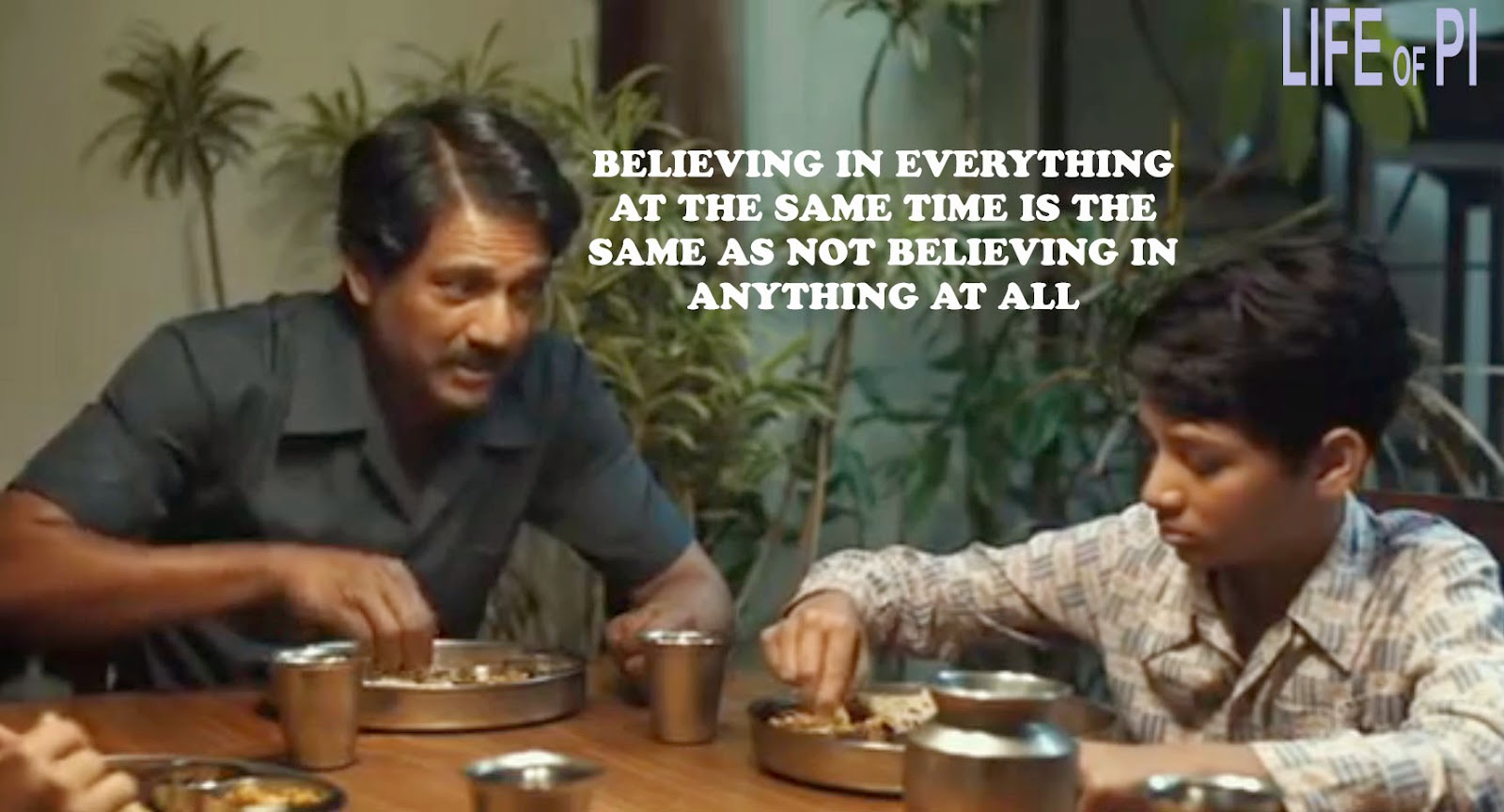
Life of Pi (quote 1)

A great line, especially for those people who say that we don't believe in any one religion but we are spiritual, or we believe in all religions.

IMDB          RottenTomatoes          Wikipedia

Sunday, April 12, 2015

Hellbound? (Quote 2)

Simply left me speechless. One of the best answers to the question many Muslims ask why doesn't Allah make everyone a Muslim? All humans are given a brain. They are required to use it, just like they use it to get secular education.
 
Life is full of difficult & hard choices, & we have to choose one option over another on a daily basis. And what choice do you make, after getting all the info you can get, in your spiritual beliefs & how to live your life, can be immensely rewarding (Heaven) or a huge failure (Hell).
 
IMDB          RottenTomatoes          Wikipedia