Showing posts with label conflict. Show all posts

Monday, August 3, 2015

'38 million people' internally displaced worldwide

The number of Internally Displaced People (IDPs) have actually increased in the 21st century, instead of going down. This is the reality of the modern world, when conflicts & wars are increasing, destroying the lives of many. For these IDPs, modernity of the modern world has actually become a curse than a blessing.

Although, the organization mentioned in the article wants more diplomacy among countries & wants more countries to work towards peace, I believe it won't happen because it's not in the interests of the large multibillion $$$ defence companies which control the strings of the politicians. These companies, i.e. Raytheon, Lockheed Martin, BAE etc. want more conflicts so their products & services are in demand. Peace means no demands for their products. That's why, Islam forbade Muslims from investing in defence companies because they would never want peace in this world.

Anyway, so where is this modern world moving towards? From my vantage point, the future of this world looks more bleak than ever.
---------------------------------------------------------------------------------


A new report has found that 38 million people have been displaced within their own country by confict or violence, with at least 11 million newly displaced in 2014 alone.
 
The global overview report, released on Wednesday by the Internal Displacement Monitoring Centre (IDMC) of the Norwegian Refugee Council (NRC) recorded a 15% increase, stating that the figures were a record high for a third year in a row.
 
Jan Egeland, the secretary-general of the NRC described the report as a wake up call for international diplomacy, reiterating that the figures are distinct from refugees who are forced to leave their countries.
 
"What it really is a damning verdict of international diplomacy, of the lack of good governance in countries, lack of regional cooperation," he told Al Jazeera from Geneva.
 
He said that conflicting governments should "sit down & discuss reconciliation & cooperation" with armed groups in order to "not pull in opposite directions, but pull in the same direction".
 
60% of all IDP's globally were in 5 countries: Iraq, South Sudan, Syria, the Democratic Republic of Congo & Nigeria.
 
Europe, for the first time in more than a decade, saw large numbers of displaced people - nearly 650,000 were displaced by the war in Ukraine.
 
'Deliberate politicisation'
 
The report highlights how 90% of all IDP's in the Middle East & North Africa regions were living in Iraq & Syria - with at least 2.2 million people in Iraq fleeing the violence propelled by the Islamic State of Iraq & the Levant (ISIL) armed group.
 
Syria has the largest number of IDP's in the world with 7.6 million people - an outcome of the brutal civil war that broke out in the country in 2011.
 
The report also highlighted how long-lasting, or protracted displacement, contributes to this alarmingly high global total. In 2014, there were people living in displacement for 10 years or more in nearly 90% of the 60 countries & territories IDMC monitored.
 
The IDMC report also describes how displacement often reveals underlying structural challenges within a country, & how it can be prolonged by a government’s deliberate politicisation of the issue or its refusal to enter into a formal resolution of a crisis.
 
Volker Turk, UNHCR’s Assistant High Commissioner for Protection, said that the staggering number of internally displaced people because of conflict & violence is a harbinger of movements to come.
 
"We know that more & more internally displaced have been forced to move within their country multiple times. The longer a conflict lasts, the more insecure they feel & when hopelessness sets in, many will cross borders & become refugees," he said.

And as we have seen in the recent past, for example in the Mediterranean, despair drives people to take their chances & even risk dangerous boat journeys. The obvious solution lies in an all-out effort to bring about peace in war-ravaged countries,” Mr Turk added.

Monday, July 6, 2015

The $18 Billion arms race helping to fuel Middle East conflict

Nothing much to say here (since, I've blogged quite a few times how members of the UN Security Council & developed countries sell weapons & arms to developing countries to keep destabilizing those regions).

The Middle East is destabilizing & turning into a war zone very rapidly, thanks to the developed countries' constant need to sell arms & ammunition to these countries, & when these weapons are used by these countries against each other or against their own public, we in the West decry how "uncivilized" these people in Middle East are.

Canada used to be considered a peaceful nation. Now, "the one Canadian deal alone – to supply Saudi Arabia with light armoured vehicles – will account for 20% of the military vehicles sold globally in years covered by the contract." That's how much Canada has changed in the global weapons market.

Why don't these developed countries sell green energy, for instance, to these developing countries? Wouldn't that be a much better investment to make the world a better place? That move alone, for instance, wouldn't create so many refugees, either, which in itself, is creating another migrant crisis in the developed countries of Europe.

Developed countries have so much modern technology in non-arms area that they could & can easily sell that technology hardware & software to developing countries & regions, & help improve lives for all. It does happen but compared to billions of weapons transactions, these transactions have not much scope & influence.

So, if we want peace in this world, the first step is to stop the developed countries to stop giving weapons to the madmen of developing countries. Who is willing to take this first step? (Per my answer, not even one developed country).
---------------------------------------------------------------------------------


The Middle East is plunging deeper into an arms race, with an estimated $18 billion expected to be spent on weapons this year, a development that experts warn is fuelling serious tension & conflict in the region.

Given the unprecedented levels of weapon sales by the west (including the US, Canada & the UK) to the mainly Sunni Gulf states, Vladimir Putin’s decision ... to allow the controversial delivery of S-300 anti-aircraft missiles to Iran ... seems likely to accelerate the proliferation.

That will see agreed arms sales to the top 5 purchasers in the region - Saudi Arabia, the United Arab Emirates, Algeria, Egypt & Iraq – surge this year to more than $18 billion, up from $12 billion last year. Among the systems being purchased are jet fighters, missiles, armoured vehicles, drones & helicopters.

The Russian declaration came only 2 days before Iraq’s prime minister, Haider al-Abadi, disclosed that he was seeking arms worth billions of dollars from Washington – with payment deferred – for the battle against Islamic State (Isis).

Last week France’s foreign minister, Laurent Fabius, disclosed progress in talks to sell Rafale fighter jets to the UAE, one of the Middle East’s biggest & most aggressive arms buyers.

With conflicts raging in Syria, Iraq, Libya & Yemen, & with Egypt also battling Islamist extremists in the Sinai, the signs that Russia is preparing to increase its own arms sales – & to the Gulf states’ biggest rival, Iran – are raising fears that tensions will be stoked further still. In particular, Saudi Arabia & Iran are facing off in the conflict in Yemen ... .

According to the New York Times, defence industry officials have notified Congress that they are expecting additional requests from Arab states fighting Isis – Saudi Arabia, the UAE, Qatar, Bahrain, Jordan & Egypt – for thousands of new US-made weapons, including missiles & bombs, to rebuild depleted arms stockpiles.

Ironically, among the key weapons suppliers in the arms race are permanent members of the UN security council who have been at the centre of 2 unconventional arms control initiatives – disarming the Syrian government’s stockpiles of chemical weapons & negotiating for a deal on Iran’s nuclear programme.

The scale of the arms race was revealed this year in reports published by IHS Jane’s Global Defence Trade Report & the Stockholm International Peace Research Institute (Sipri). They showed how Saudi Arabia had become the world’s largest importer of weapons & fourth largest military spender & that other Middle East states were sharply increasing their arms purchases.

Adding to the concern is the fact that the spending spree on arms comes against the background of a marked increase in military interventions by countries in the region since the Arab spring in 2011. Saudi Arabia has intervened in Bahrain (at the request of that kingdom’s ruler during the so-called Pearl revolution), in Yemen in 2009 & again in Yemen this year.

And among those concerned by Saudi’s new military assertiveness - on the back of its arms buying spree - was the Iraqi prime minister, Abadi. “The dangerous thing is, we don’t know what the Saudis want to do after [their intervention in Yemen],” Abadi told US reporters last week. “Is Iraq within their radar? That’s very, very dangerous. The idea that you intervene in another state unprovoked just for regional ambition is wrong. Saddam has done it before. See what it has done to the country.”

And if the Saudi intervention in Yemen has been overt, no less real has been the proxy conflict that has set Iran & the Gulf states against each other in Syria, where Tehran has backed the government of Bashar al-Assad with military assistance & weapons, & Gulf states have backed different rebel groups, including Islamist ones.

It’s crazy,” says Ben Moores, author of IHS Jane’s annual report on arms buying trends. “The one Canadian deal alone – to supply Saudi Arabia with light armoured vehicles – will account for 20% of the military vehicles sold globally in years covered by the contract. And this is just the thin edge of the wedge. Saudi has booked enough arms imports in 24 months for them to be worth $10 billion a year.”

While some countries, such as Kuwait, are in the process of modernisation, a key trend identified by Moores is how states are retooling to fight insurgency conflicts in the same way the US military has in Afghanistan & Iraq. “Look at UAE, Saudi Arabia, Egypt & Algeria. They were all countries that bought a lot of conventional arms in the past that are no use in a sectarian war or an insurgency.

If you look at what was bought at the recent Idex arms fair in Abu Dhabi, it was drones, high-end surveillance satellites, strategic transport aircraft for projecting power. One of the reasons Egypt went with its recent purchase of Rafale jets [from France] is because it wanted planes that could deliver precision-guided standoff weapons.”

And as Tobias Borck of the Royal United Services Institute points out, states in the Middle East are now more prepared to use the weapons they are buying. “[The] Saudi-led military operations in Yemen [are] the latest manifestation of Arab interventionism, a trend that has been gaining momentum in the Middle East since the uprisings of the Arab spring,” he says. “Middle Eastern countries appear to be increasingly willing to use their armed forces to protect & pursue their interests in crisis zones across the region.”

Referring to the inconsistent approach by key security council members towards arms control in the region, he adds: “There are a lot of different streams feeding into this arms race. On Syria’s chemical weapons & the Iranian nuclear programme, the 2 issues were ring fenced as pure arms control questions. When it comes to how we perceive our arms sales – whether they are British or US or whatever – it tends to be seen as a domestic economic issue – protecting our factories.

That neglects the regional political dimensions, with arms sales taking place with a lack of regard for that context & without long-term strategic awareness.”

Borck says that the scale of the arms being supplied to countries such as Saudi Arabia & the UAE by the west may also be acting as an incentive for Russia to get back into the Middle East – not least via arms sales to its old clients such as Iran – & may have been a motivating factor in the Kremlin’s decision to lift the ban on the delivery of the S-300 missile system.

Putin, defending the decision to supply the missiles during a call-in television show last week, cited Russia’s prerogative to pursue its own foreign policy initiatives & suggested that the missiles could represent “a deterrent factor in connection with the situation in Yemen”.

Omar Ashour, an expert on Middle East security issues at Exeter University, has sounded a further note of caution, this time over the intentions of the new Saudi-led Arab coalition, warning that its interventions are unlikely to contribute to stability. “The rise of Arab military coalitions raises serious concerns,” he wrote in a recent piece for Project Syndicate. “Such interventions were usually aimed at empowering a proxy political force over its military & political rivals, instead of averting humanitarian disaster or institutionalising a non-violent conflict-resolution mechanism following a war.”

Speaking to the Guardian last week, he added: “On top of that, the increases in arms sales are bound to be extremely destabilising. At the moment most of the interventions have been against softer targets – Saudi Arabia targeting guerrillas in Yemen; Egypt against Bedouin in Sinai; or strikes against ragtag armies in Libya. But if the ‘soft’ keeps being hit hard, they won’t remain soft. They will find their own patrons & proxies & hit back & it will lead to a vicious cycle.”

Pieter Wezeman, a senior researcher at Sipri, which maintains a database tracking arms contracts, raises another concern. “Something that doesn’t get mentioned is the complete lack of interest in arms control among the countries in the region. It is not in the minds of leaders & decision-makers, except for the need to arm to defeat any potential opponent.

There is already instability in the region on several levels. You have instability in Yemen, Syria & Iraq. There is instability between Iran & the Gulf states. What is important now is how the massive expansion of the armed forces of Saudi Arabia, UAE & Qatar will be seen as posing a clear threat to Iran.”

Borck adds a final warning: “If you are going for an ever bigger hammer, then the more desperate you are to make every problem a nail.”

Tuesday, June 16, 2015

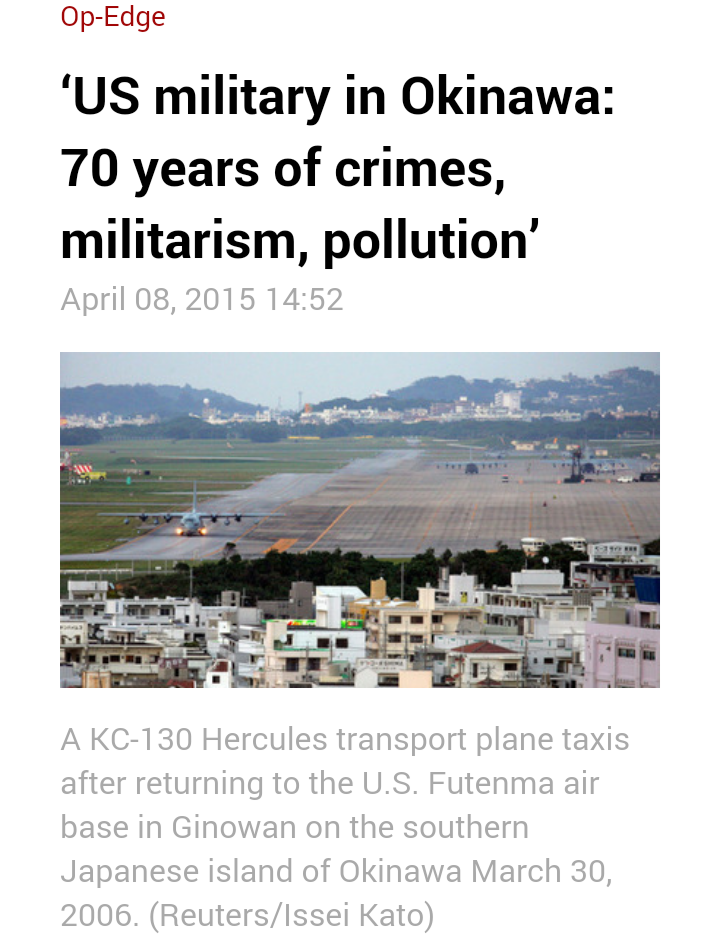
US military in Okinawa: 70 years of crimes, militarism, pollution

The question to ask here is that why US puts its military all over the world. I read somewhere that there are almost 400 US military bases in almost 135 countries in the world. Per Wikipedia, Japan has almost 95 bases (army, navy, air force, & Marine corps). What's the point of putting 95 bases in Japan or almost 65 in Germany? Are these countries still a threat to US? Is this the so-called "democracy" when people of another sovereign nation wants something (to kick Americans out of their own country) that they can't do that?
---------------------------------------------------------------------------------


Okinawans are not likely to back down & will continue to struggle for the dismantling of the US base, said journalist Jon Letman. Americans should also speak about the suffering of people of Okinawa & support changes in the region, he added.
 
There has been a confrontation between the Tokyo government & Okinawa authorities over the US military base on the southern Japanese island. Tokyo continues to back the idea to relocate the Futenma airbase from one part of Okinawa to another. Governor Takeshi Onaga backed by protesters claims the US presence damages the environment, & sparks more crime involving the US military.
 
... independent journalist Jon Letman ... explained that the conflict dates back to 1995 when three US servicemen from Camp Hansen kidnapped & raped a 12-year-old Japanese girl.
 
The high-profile case was largely behind the decision to relocate the Futenma airbase, which was located in the very crowded area of Ginowan City – “to the north of the island to a sparsely populated part of the island,” he said.
 
However, there have been protests against the move. Asked whether the Okinawa Governor Takeshi Onaga will manage to stop the construction of the new military base, the journalist said: “That is a question that everybody has been asking, & so far, he has not been [able to do so]”.

This is going to be a long-running conflict that appears, it could be a protracted battle in the courts. They have already kind of started out there. The governor has called for the stoppage of seabed drilling, & that was countered quickly by the fisheries minister immediately after. So this has already headed towards the courts. So we will see if Governor Onaga is going to continue with this & how much pushback he is going to face from Tokyo & from Washington,” Letman told RT.
 
He said that Onaga “has got the people behind him for sure in Okinawa.”
 
You have got an overwhelming majority of people who have had it for 70 years - of being occupied, militarism, crime, pollution, noise that goes along with these bases,” he added.
 
Letman said that governor definitely has support among the locals. However, Washington & Tokyo are pushing very hard for this base.
 
The journalist argues that the main grievances that Okinawans have are sexual violence & crime, & the noise that goes along with these bases.

The fact that you’re moving from a very crowded, densely populated place to a place that is really pristine - Henoko & Oura Bay which is one of the most beautiful & pristine undamaged parts of East Asia, particularly in Japan, that have got incredible biodiversity…So all these things are facing threats from this increased militarism,” Letman told RT.
 
He said that moving this base will not solve the problem: “That seems very unlikely. I don’t think that the people of Okinawa are going to back down. They have been protesting 24/7 for many hundreds, if not thousands of days. It doesn’t seem likely that they would back down. This is something that needs to change...
 
I would like to see more Americans who are directly involved in this, & indirectly involved be far more aware & to speak out & to say: ‘Hey, we are not going to be part of this, we don’t want to be pushing this on other people, they have been dealing with this for 70 years. It is time for change!’” he added.
 

Catherine Fisher - first rape victim to speak out
 
It took 12 years for one of the victims, Catherine Fisher, to get justice.
 
RT: It's not easy to go public with a story like yours. Can you tell why did you do it?
 
Catherine Fisher: At first I thought obviously I was the only rape victim in Japan by US military servicemen. But after doing my own research I realized that for the past 70 years US military servicemen have been raping, murdering & committing crimes against Okinawans ... Nobody was speaking up about it – the servicemen had received immunity. That is the reason why I wanted to speak up.
 
RT: Why do you think the perpetrator of the crime didn't face justice?
 
CF: I’ve been told that it is due to the secret agreements that were in place at that time. In my own case I was treated like a criminal & I had to look for the rapist by myself. When I finally did find him 10 years later the Japanese government …when I had a meeting with them, I said: “Would you please send my court documents to the US?” And they said that they could not afford to send such documents there. They couldn’t even afford a postage stamp. And that is why I had to still continue & file a case in the US.
 
RT: Do you think the situation has changed since your attack, & Okinawan are facing fewer crimes now?
 
CF: I would say no, nothing has changed… I’m working with 3 different cases at the moment which are not US military servicemen … But the Japanese police & the court system here is so outdated & nothing has changed in my opinion.
 
RT: The incident happened over 10 years ago but just a short time ago you have started openly sharing your story. Why now?
 
CF: I wrote a book which took me 13 years to write. That will be published in Japanese in May of this year which is quite soon. But the thing is if nobody speaks out then nothing can change, & it is through the sufferings of human beings that the world would advance. Basically I couldn’t just leave & go back to Australia when there is so much here to be done. There weren’t even 24-hour rape crisis centers available in this country in this century- it is just unbelievable. It was a grassroots movement that started all of this & I was the first rape victim to speak to out in public.

Wednesday, June 3, 2015

Made in Britain? The Saudi-led attack on a Yemeni refugee camp

A great opinion piece by Giles Fraser in the Guardian.
--------------------------------------------------------------------------------


On Monday, a Saudi-led coalition apparently dropped bombs on a refugee camp in northern Yemen. It’s perfectly likely that, as they have admitted before, the Saudis may have used jet fighters that were made in the UK. After all, Saudi Arabia is the UK defence industry’s largest export market. More than 40 innocent people died. Around 200 were injured, many seriously. The Yemeni state news agency showed pictures of dead children laid out on the floor.
 
Apparently, the Saudis were trying to hit a nearby Houthi rebel position. “It could have been that the fighter jets replied to fire, & we cannot confirm that it was a refugee camp,” said a spokesman for the Saudi regime, lamely. Well yes, it was a refugee camp, confirmed the UN. And if the Saudis invade Yemen, thus further extending the widening gyre of Sunni/Shia conflict, expect a lot more of the same. ... And if you think it has little to do with us, that’s because we do not choose to remind ourselves that it may well be Rolls-Royce engines, made in Derby, that will be roaring through the sky, & Eurofighters assembled in Lancashire, that will be doing the bombing. We say little because we have a multibillion pound conflict of interest. We supply the weapons, then throw up our hands in horror when they are used.
 
Perhaps I also ought to declare an interest. I fell in love with Yemen back in the 90s. Its searing heat, its desert, its ancient architecture, its fearsome mountains. I would lie on the top of our flat roof in Taiz & hear the call to prayer floating over the city, echoed by the barking of wild street dogs. There was little to distinguish any of this from the middle ages – except for trucks, a few Aston Villa football tops, lots of dodgy looking eastern European weaponry & the cigarettes that my friend was flogging out of the back of his Toyota Land Cruiser.
 
Yes, Yemen was a political basket case. Indeed, the very idea of some overarching national entity called Yemen hardly shaped the local consciousness. This was a collection of semi-autonomous tribes & communities, especially up in the mountains. They were keep-themselves-to-themselves kind of people. Most of the men spent much of their time lying around chewing khat, a sort of pointless amphetamine version of spinach. I passed my time playing chess with the lepers up at the leper colony run by Mother Teresa’s nuns. Despite the dysentery, despite the humidity, despite the suicidal driving & terrible food, I loved it. It had a wild, epic grandeur & the people a fierce independent mindedness. It doesn’t deserve to be a geo-political battleground for a proxy war between Saudi Arabia & Iran. Indeed, where does?
 
I offer this personal reminiscence because I want to try to humanise a place that can easily seem like little more than a name on a map. Not many people from the UK have reason to visit the Yemen. But this is not to say that we are not up to our necks in this war – worse, we are massively profiting from it. Back in 2012 David Cameron & Lord Stephen Green (of HSBC fame) led a trade delegation to Saudi Arabia, flogging our weapons of war. The coalition government has licensed £3.8bn of arms to a Saudi dictatorship that regularly decapitates its subjects, retains the death penalty for conversion to Christianity, prevents women from having basic human rights, & has exported its extreme version of Wahhabi Islam to other parts of the Middle East, inspiring the likes of Islamic State, to catastrophic effect. “Ethics & values are important to us. They define how we behave towards others & play a major part in how we’re creating a responsible business,” says BAE Systems, who manufactures Eurofighter. That’s a sick joke.
 
Think about it: if Israel had dropped bombs on a Palestinian refugee camp in Lebanon, it would be on the front page of every paper. But when the Saudis do it, there is hardly a bat-squeak of interest. We fly our flags at half-mast when their king dies. Even a supine Westminster Abbey pathetically follows suit. And all because of Saudi oil money. We ought to be thoroughly ashamed.

Tuesday, June 2, 2015

Former Blackwater gets rich as Afghan drug production hits record high

So who benefitted from Afghanistan war? American & Afghani politicians & American contractors.

Who lost from Afghanistan war? American troops, Afghani military & civilians, & American public (billions taken from them & given to contractors & in the end, causing a recession).
 

End result: Taliban are back in full force. World drug market is flooded with drugs derived from opium.

Is this a successful end of a decade-long conflict?
---------------------------------------------------------------------------------


In a war full of failures, the US counternarcotics mission in Afghanistan stands out: opiate production has climbed steadily over recent years to reach record-high levels last year.
 
Yet one clear winner in the anti-drug effort is not the Afghan people, but the infamous mercenary company formerly known as Blackwater.
 
Statistics ... reveal that the rebranded private security firm, known since 2011 as Academi, reaped over a quarter billion dollars from the futile Defense Department push to eradicate Afghan narcotics, some 21% of the $1.5 billion in contracting money the Pentagon has devoted to the job since 2002.
 
The company is the second biggest beneficiary of counternarcotics largesse in Afghanistan. Only the defense giant Northrop Grumman edged it out, with $325m.
 
According to the US inspector general for Afghanistan “reconstruction”, the $309m Academi got from US taxpayers paid for “training, equipment, & logistical support” to Afghan forces conducting counternarcotics, such as “the Afghan National Interdiction Unit, the Ministry of Interior, & the Afghan Border Police”.

Far from eradicating the deep-rooted opiate trade, US counternarcotics efforts have proven useless, according to a series of recent official inquiries. Other aspects of the billions that the US has poured into Afghanistan over the last 13 years of war have even contributed to the opium boom.
 
In December, the UN reported a 60% growth in Afghan land used for opium poppy cultivation since 2011, up to 209,000 hectares. The estimated $3 billion value of Afghan heroin & morphine represents some 15% of Afghan GDP.

Given the growth in opium poppy cultivation, it must be assumed that the Taliban’s income from the illegal trade in narcotics has remained an important factor in generating assets for the group,” the UN reported.
 
That same month, the US inspector general for Afghanistan warned that the opium trade would surely rise as international aid money flees the country with the winding down of the war. Yet the inspector general also noted that US reconstruction projects, particularly those devoted to “improved irrigation, roads, & agricultural assistance” were probably leading to the explosion in opium cultivation.

“[A]ffordable deep-well technology turned 200,000 hectares of desert in southwestern Afghanistan into arable land over the past decade,” the inspector general found, concluding that “much of this newly arable land is dedicated to opium cultivation”.

Academi & its former Blackwater incarnation have an infamous history in Afghanistan. It once set up shell companies to disguise its business practices, according to a Senate report, so that its contracts would be unimpeded by company employees’ killings of Iraqi & Afghan civilians.
 
Blackwater’s founder, Erik Prince, sold the company – then renamed “Xe” – in 2010. Under new ownership, the firm occasionally gestures toward emphasizing its original business training military & police personnel, but it has never quite divested itself of its security contracting business.
 
In 2010, Blackwater was one of a group of firms selected by the State Department for its $10 billion contract to protect its diplomats worldwide, precisely the mission Blackwater performed when its agents opened fire on Iraqi civilians at Baghdad’s Nisour Square in 2007 & turned the company into the ugly face of private security. The following year, the firm’s newly installed CEO pledged, “We’re not backing away from security services.”

Monday, February 23, 2015

Inch'Allah, a great movie

Loved this great Canadian-French movie ... gives the viewer a perspective (correct, from my viewpoint) on the occupation & war in Israel & Palestine.

People in the West think & defend Israel's right to attack Palestinian lands (e.g. Gaza bombing in 2014) because "Palestinians conduct suicide bombings in Israel to kill Jews & spread terror in Israel." We don't think why that suicide bomber blew him/herself up. Everyone loves to live & enjoy life. Killing oneself is extremely hard & requires lots of courage.

Spoiler Alert: Film starts with a suicide bomber blowing up a café in Israel. Then it goes back & shows what led up to that suicide bomber blowing herself up. A young, pregnant Palestinian friend of the Canadian doctor (pictured) loses her newborn baby, minutes after giving birth, because she gave birth at a checkpoint & Israeli soldiers wouldn't allow her to go to hospital, & couple days later, her husband was sentenced by Israel for 25 years. So, she effectively lost her whole family in couple days. What she got to lose by blowing herself up? Does she have anything to live for?

As one of my previous post with a Aleksandr Solzhenitsyn's quote from movie, Cloud Atlas, shows that "Rob a man of everything & that man will no longer be in your power."
What's that Palestinian woman got to lose when she is robbed of everything in this world? How many lives could have been saved in Israel if that Palestinian woman would've been allowed to go to the hospital? Would she still blew herself up after hearing about her husband's sentence but still have her baby to look after, who would've been a symbol of hope & life for her?

IMDB          RottenTomatoes          Wikipedia

Monday, February 9, 2015

Why I gatecrashed a banquet for arms dealers

Since, Independent news site is a paid-subscriber site & one may not have access to it (like me), I've posted the whole article below:
------------------------------------------------------------------------------------------
 
As I waited for the right moment to take the stage at last night's annual ADS dinner, I was surrounded by a world where luxurious dinners reward the business of selling the tools of death & repression. In a room full of leading politicians, civil servants & arms dealers, I began to wonder: which ones were responsible for what crimes?

Had the people in this room been among those who sold the weapons to Israel that were used in the assault on Gaza, which killed 2,105 Palestinians & 495 children? Were they among those who had sold the tear gas used against democracy protesters in Hong Kong? Was it here that MPs were persuaded that renewing the UK's nuclear weapons is a necessity, or that buying useless aircraft carriers for billions of pounds was a good idea?

What about the UK weapons that have been used by oppressive governments in Iraq, Afghanistan, Egypt & Bahrain, & the sign this sends out? When the UK sells arms to tyrannies it acts as a signal of support for the human right abuses that are taking place in those countries.

I was seconds away from speaking in front of representatives from MBDA, a missile company that armed the Gaddafi regime; BAE Systems, which is Europe's biggest arms company. I wasn't on the speakers bill, I wasn't meant to be there, but I felt like I had to be there.

The ADS isn't just another trade body: it represents some of the biggest arms companies in the world. It spends a lot of time & money on lobbying politicians & trying to sell as many weapons as it can to anyone who will buy them. Along with the Campaign Against the Arms Trade, I wanted to be there to make sure any illusions they had that they were working in a publicly acceptable business were well and truly shattered.

Their power is obvious. When I looked through the guest list it became apparent that there were over 40 MPs in the room, as well as lots of top ranking civil servants & Ministry of Defence personnel. It is this kind of access to politicians which means arms company interests are put before those of ordinary people.

I'm 5 months pregnant, & am worried that before my child can even talk, he will have lost opportunities. My local council is talking about closing children's centres & shutting its youth centres in the coming year. That's bad enough without even thinking about the loss of free further education, & how he'll manage to house himself in a post-austerity UK, or whether a decent job will still exist.

So for me, the reasons why I found the courage to stand up to hundreds of arms dealers as they lobbied our politicians for more military spending feel very personal. But I was there with others, many of whom stood in the freezing cold to challenge the arms dealers as they arrived.

We did it because these people profit from enabling & encouraging conflict, & from selling their weapons to some of the most oppressive governments in the world. The politicians help: they make sure the government pull out all stops to promote these arms companies & their deadly wares. In the last 4 years alone, the Coalition government has licensed £3.8bn worth of arms to Saudi Arabia, a dictatorship with an appalling human rights record.

I don't want my son to grow up in a world where arms dealers can make millions of pounds through encouraging war. I want him to grow up in a world with different priorities, a world that puts social & environmental justice ahead of militarism and war.

I am still wondering why the arms dealers clapped when I spoke. Some were certainly applauding the security as they managed to silence my challenge. For others, I think, clapping was a way of trying to neutralise what I was saying, of staying distant from their own humanity.

But I didn't go there expecting to change hearts or minds. I went there to make sure they knew that ordinary people don't accept their skewed priorities; that we will challenge & expose them as they influence the political agenda; that they can't expect to carry out their business as if it was any other.

I think it is possible to end the culture of militarism & war & to assert human needs over arms company interests. It starts when any of us stand up & say enough is enough.