Showing posts with label faith. Show all posts

Friday, February 9, 2018

Years after Enron, business is still behaving badly

This is a good opinion piece on how ethics was the word-du-jour at the turn of the 21st century after the bankruptcies & crises of Enron, Tyco, WorldCom etc., but nowadays, it seems that the ship has not sailed much since then.
The corporate behaviour & corporate governance were supposed to improve & become much more ethically driven in the new century. However, that dream is not coming to fruition. Unscrupulous business leaders are abound & ethics & morality are out the window at most corporations around the world. Why is this so?
Here, the author of this opinion piece & I differ, as to the reasons of these unethical practices in the business world. Mr. Stern, the author of this opinion piece, takes the secular view that punishments have been feeble & lacking for those unethical business leaders, & if the punishments become stronger, then businesses would become much more ethical.
However, those punishments can only be made tougher by the judiciary branch of the government. Ironically, that branch is indirectly controlled by those same unscrupulous business leaders, who are supposed to be severely punished for their unethical practices. Business leaders make friends, lobby, & perhaps, fund the political leaders who they think will further their views & agendas in the political fields. Those political figures then pick & choose the judiciary, who are then supposed to be making new rules & punishments. Since, everyone is connected politically, nobody is going to stab anyone in the back.
Problem is that ethics & morality are arbitrarily measured in the secular world. Everyone has a different yardstick to measure them. One's ethics on a matter can be quite different from another's. This creates huge differences of opinion. For instance, one would think that a living wage for all employees should be ethically driven idea & every senior manager should lobby for it in its organization. However, that can reduce the net profits, which in turn, can affect the Earnings-Per-Share (EPS) firgures, which in turn, will reduce the value of the shares. I don't think that wealthy shareholders & institutional shareholders would be very happy with that.
Ethics & morality can only be same, when everyone, in a specific society, believes in a religion. Religion sets the same bar for ethics & morality for everyone in the society. Ethics & morality cannot exist without religion, regardless of what that religion is. Essentially, all religions preach the same basic values, so the same basic ethical guidelines would come to fruition when the society, & the business people, look to religion for their ethical compass, instead of human made laws.
------------------------------------------------------------------------------
Respect, integrity, communication and excellence. Those were Enron’s core values, which, the energy company said, guided its behaviour as a “global corporate citizen”. We know how that story ended: bankruptcy, court cases and (unusually for the business world) custodial sentences. The once-mighty accountancy firm of Arthur Andersen was also brought down.
Over a decade later bad corporate behaviour – the stuff we find out about, anyway – continues to make front page news. That dependable, “clean diesel” Volkswagen turns out not to be so clean after all. Thomas Cook takes an age to come up with a decent and civilised response to human tragedy. And now Sports Direct is revealed to be conducting business in a brutal fashion. Boardroom practices at the company may be comically bizarre, but life in their Shirebrook warehouse is not funny at all.
The public have noticed. A survey (pdf) this week for the Institute of Business Ethics found that 39% of people think business is behaving unethically. The three biggest causes for concern are tax avoidance, executive pay and exploitative labour practices. Two-fifths of the public have given a vote of no confidence in British business. That is, potentially at least, a lot of customers.
Why, apart from the headline-grabbing scandals, is business seen in such a poor light? To some extent this represents a failure of the “corporate social responsibility” (CSR) movement. Bad CSR deserves to fail and be seen for what it is – a flimsy public relations exercise. Good companies don’t need CSR programmes. They think hard about their activities and the impact they have on the world. They worry about how they make their money. Good companies make sustainable profits, and don’t externalise the costs of doing business on to the world around them.
But why does bad corporate behaviour still exist? The chances of getting found out are much higher than in the past. Everyone carrying a smartphone is equipped with a vital tool of investigative journalism.
Fearlessness, or shamelessness, may have something to do with the “risk/reward relationship”, as it is called in the financial world. The rewards for breaking the rules can be high. But the punishments are often feeble – fines (merely another cost of doing business) and loss of reputation (cushioned by a healthy bank balance and lifetime financial security).
Very few business leaders have ended up behind bars on account of their actions. “You’re going to jail!” screamed angry protesters at Dick Fuld, the former chairman and CEO of Lehman Brothers, in 2008. But he isn’t going to jail. He is going to his midtown Manhattan office to work for his new business, Matrix Advisors.
Perhaps bad corporate behaviour is explained by the fact that, whether they realise it or not, some senior executives are still coming to terms with the post-financial-crisis world. Deep down they fear it could all go wrong again, any time. They are in a hurry and are cutting corners. They also seek extravagant pay packages to cushion their ultimate, inevitable fall.
So, yes, sanctions have to get tougher, and the fear of punishment for wrongdoing has to increase sharply. One encouraging sign is that some responsible business leaders have had enough of the opprobrium brought on their heads by others. Simon Walker, director general of the Institute of Directors, said this week: “IoD members share the public’s outrage… I urge people to remember that Sports Direct is categorically not a representative of British business.”
He is right about that. And we as customers cannot complain if we continue to shop with businesses that at other times we might denounce loudly as unethical. We are all in this together.
My friend Steven Gauge has written a lovely play about taking up rugby again in middle age, called (perhaps inevitably) My Life as a Hooker. In one scene he is nervously running out on to the pitch for the first time in decades, and confesses to a team-mate that he is probably a bit rusty about the rules. Don’t worry, his fellow paunchy sportsman tells him: “Just cheat until you get caught.” This would have made a more accurate mission statement for Enron. Sadly, it appears to be the guiding ethos for too many people in business today.

Wednesday, July 8, 2015

Criminal Minds, S1E9 Quote

So true ... whatever that belief / faith might be, the believer should so strongly believe in that belief that it should possess its mind.


Thursday, June 18, 2015

Confessions of a failing Catholic

A good opinion piece. This is one of the main reasons why Catholic Churches in Europe & North America are sitting empty, while other religions are thriving. Although, there are some different reasons for other religions increasing their numbers, the main reason is the community support, which in itself is done through the leadership.

Most psychologists agree that humans have an innate desire to follow a supreme being. And in following that, they look towards the supporters & leaders of that religion. Most do it through an organized religion but some also do it on their own. I'm not judging here, who is right or wrong.

But when leaders themselves are not principled, their actions don't follow what they preach. People are not stupid enough to not see that. When they see their religious leaders not doing what they preach, they start to lose their own faith, which, in turn, adversely affects the perception of the whole religion.

This is also happening in other religions, albeit more slowly than the Catholic Church. Money is the new religion, which requires no rules & restrictions. No morals or ethics are required in this new "religion". Religious leaders are losing their principles (assuming they had principles in the first place) & people losing interests in their religion & faith.

Seeing the corruption of their "childhood" religions, some people start to look elsewhere & convert. However, that's a very involved & soul-searching process, & not everyone wants to mentally tire themselves in finding out the meaning of life. Sometimes, those people who convert start to see the corruption of their newfound faith, & then they move again or they lose interest in organized religion at all.

At the end of the day, religious leaders need to be principled & do what they say. If they believe that they can't uphold the principles & values of the religion they are preaching, then they should resign themselves from their posts, so they don't spread their own corruption into the community. Leadership is a very responsible post; be it of any organization, secular or religious. Leaders need to keep in mind that the eyes of the whole community are on them. If they slip up, then it will adversely affect the whole community.

A strong sense of community is very much in demand in today's world, & people will flock to that organized religion which offers them that sense of community, the most. They may even join a cult just for that community feel. So, religious leaders have to correct their compass & be steadfast on it, because, if they lose their compass, the whole community starts to go astray.
---------------------------------------------------------------------------------


I’ve had bad luck with my priests.

The first one was Father Albert, a warm, charismatic & eloquent man who figures prominently in my childhood memories. He was almost a member of our family. But then one day he disappeared without explanation.

Father Albert was replaced by a young, bearded, barrel-chested priest who played bass guitar. I once saw him throw a football 60 yards. Then he also departed in a hurry. We heard later he’d been sleeping with a woman in his band.

In my twenties, my priest was earnest & awkward, with an off-kilter wit. I didn’t get to know him very well before he, too, fell in love with a woman in the parish, someone who he had been counseling. The Church sent him away quickly.
 
Father Joe, my last priest, was a friendly man who disarmed everyone with his maritime accent & humorous sermons. As far as I know, he never started a romantic relationship with anyone. Instead, he went to jail for stealing several hundred thousand dollars from the parishioners.
 
You would think with spiritual mentors like that I would walk away. I did, for a few years after college. It wasn’t a conscious decision of humanist rebellion. I was simply busy. Sundays came & went, & there were far too many things to distract me.
 
In my thirties I moved to a new city & found a tall stone church down the street. The nave was cool in the summer heat, & colourfully lit by soaring stained-glass windows. The oak pews were dark with age & worn smooth by generations of use. I felt at home, & began to attend mass again, albeit irregularly.
 
But I’m not a natural joiner & always sat at the very back. I was raised a Catholic, attended Catholic schools, & even have priests in the extended family. But I am only comfortable attending mass if I am near the door, to reassure myself I am merely stopping in, & can leave at any time. And I have. Not long ago a guest priest began to explain how families were being torn apart by the professional aspirations of women. I gathered up my 2 daughters & we went for ice cream.
 
But my problems with Catholicism go well beyond the occasional fatuous sermon. The Church’s treatment of women remains medieval. Its discrimination against gays & lesbians would be considered criminal were it any type of secular organization. And even though 39 million have died from HIV/AIDS, Rome still fights to restrict access to condoms. If the Pope had given each of those people Last Rites, one after the other day & night, it would have taken him over 30 years.
 
I also have struggled hard with my faith itself. As a child I listened to the Book of Genesis with a skeptical ear. Growing older, I struggled with the idea that even the most virtuous non-believers (like my father) would go to hell. Later I tried & failed to reconcile the concept of free will with God’s will. I have never understood why the Supreme Being, ruling over the entire universe, would smite me unless I flattered him with rote prayers. And the few times I have found myself in extremis, it wasn’t Christ who came to mind; it was thoughts of my parents, or in later years my children.
 
I am technically a heretic but I still call myself a Catholic. My ethical compass, wavering though it may be, is clearly Augustinian. I still go to mass. I still sit in the back. I close my eyes & listen to the hymns & feel the sun on my face as it filters through the great windows. My church, though, is steadily emptying. Obviously, Father Joe’s arrest cleared out many of the pews. But across the country, attendance has declined while atheism has risen. Only one of my friends attends a weekly service with any regularity. I go less & less, myself. But I still go.
 
For me, church is not about my faith; it is about my community. I never linger for the bake sales & I can’t tell you the name of the new priest (my history suggests he won’t be around very long anyways). I don’t even know any of the other parishioners by name. But I recognize most of their faces, & from my vantage point in the last pew all of their backs. And that is a profound comfort.
 
My life is lived by email & phone call. My friends are dispersed, my family spread far & wide. My relationships are mostly virtual, kept alive by text messages & Christmas cards. Like most of us, I am connected to thousands, but honestly know only a few. Even though we never speak, the sight of the familiar strangers in church gives me a physical sense of community, of tangible belonging.
 
For millennia, humans were born, lived & died within the same few miles. They did not know very many people, but they knew them well. Their sense of identity was less about who they were than where they belonged. Then, in the span of a few generations, this all changed. We began to travel, to disburse, to bond with TV characters, to create online networks, to disappear into our inboxes. At the moment when we have never been more isolated & more in need of a real community, the Church has failed to provide it. It is perhaps one of the great ironies of our age. Archaic doctrine. Repressive rules. Institutionalized bigotry. Abuse scandals. Unapologetic bishops. It was almost as though Rome was trying to alienate us.
 
After drafting this column, I decided to find out what happened to Father Albert, the smiling man who gave me my first communion & then vanished. A couple of calls informed me that he’s gravely ill, apparently, in an old age home. And, while it took 20 years, he is now facing charges for sexual assault & gross indecency. They are not sure if he will live to see his trial date later this year.

Tuesday, June 9, 2015

The science is in: God is the answer

A great article. It lays out the science, & scientists' & researchers' narratives for both sides of the argument that believing in a "higher power" is good for your health & believing in a "higher power" is all bonkers. So, the reader has to make up his/her own mind what they think is correct or take it merely as FYI.

What I found interesting is that believing in a "higher power" by an individual, from the heart & mind of that individual, helps that individual deal with life much more resolutely. It becomes a debate about religion vs ritual. People (as teenagers or adults) follow a religion blindly & never question it or reason with it. They don't build on that thinking of logic & reasoning with those hard questions of life. Belief in spirituality or religion has to come from within, & should not be imposed by an outsider (be it a very loving parent).

So, the parental advice from this long article is that, parents should not force their kids into believing a certain religion or spirituality movement or even atheism. Be there as a guide for your children, especially, in their troubled teen years. In those years, those teens will try to form their own identity & hence, will seek out religion / spirituality or even atheism, to deal with their problems & issues. Parents need to be with their teenage kids as their guide & help them along in the exploration of hard questions of believing in a "higher power". Do not be alarmed or desert them if they choose to believe in a religion or movement, which conflicts with your sense of believing in a higher power.
---------------------------------------------------------------------------------


18 years ago, Lisa Miller, now the director of clinical psychology at Columbia University’s Teachers College, had an epiphany on a New York subway car. She had been poring over the mountains of data generated by a three-generation study of depressed women & their children & grandchildren. The biological trend was clear: Women with severe—& particularly with recurrent—depression had daughters at equally high risk for the psychological disorder. At puberty, the risk was 2 to 3 times greater than for other girls. But the data seemed to show that the onset &, even more so, the incidence of recurring bouts with depression, varied widely.
 
Miller couldn’t discern why. Raised in a close-knit Midwestern Jewish community, she had already looked for what she says psychologists rarely bothered to seek—religious belief & practice—& found some mild benefit for both mothers & children, but nothing that stood out among the other variants, such as socio-economic status. Then came the subway ride.
 
She was in a subway car crowded at one end & almost empty at the other, because that end was occupied by a “dirty, dishevelled man” brandishing a piece of chicken at everyone who boarded while yelling, “Hey, do you want to sit with me? You want some of this chicken?” The awkward scene continued for a few stops until an older woman & a girl of about 8—grandmother & granddaughter, Miller guessed—got on. The man bellowed his questions, & the pair nodded at one another & said, “Thank you,” in unison, & sat beside him. It astonished everyone in the car, including Miller & the man with the chicken, who grew quieter & more relaxed.
 
The child’s evident character traits—compassion, acceptance, fearlessness—at so young an age prompted Miller’s eureka moment. What struck her was the nod & all it implied: “It was clear as day that the grandchild fully understood how one lives out spiritual values in her family.” 20 minutes later, Miller was in her lab, running equations on the data that were, in effect, a search for “the statistical nod.” She was looking for mother-teen pairs who had reported a shared religion or non-religious spirituality. She calls the results “the most amazing science I had ever seen.” In the pairs Miller found in the data, shared spirituality (religious or otherwise)—if it reached back to the child’s formative years—was 80% protective in families that were otherwise at very high risk for depression.
 
It was the start of a long & sometimes rocky road for both Miller & the place of spirituality—however defined—in mainstream psychological thinking. ... But Miller & other researchers, including so-called “spiritual” neuroscientists like Montreal’s Mario Beauregard & the much-cited American psychologist Kenneth Kendler continued to explore the intersection of religiosity & mental health in studies published in major, peer-reviewed science journals. By the end of it, as Miller sets out in a provocative new book, The Spiritual Child ..., she was convinced not only of spirituality’s health benefits for people in general, but of its particular importance for young people during a stage of human development when we are most vulnerable to impulsive, risky or damaging behaviours.
 
In fact, Miller declares, spirituality, if properly fostered in children’s formative years, will pay off in spades in adolescence. An intensely felt, transcendental sense of a relationship with God, the universe, nature or whatever the individual identifies as his or her “higher power,” she found, is more protective than any other factor against the big 3 adolescent dangers. Spiritually connected teens are, remarkably, 60% less likely to suffer from depression than adolescents who are not spiritually oriented. They’re 40% less likely to abuse alcohol or other substances, and 80% less likely to engage in unprotected sex. Spiritually oriented children, raised to not shy from hard questions or difficult situations, Miller points out, also tend to excel academically.
 
And teenagers can use all the help they can get. Recent research has revealed their neurological development to be as rapid & overwhelming as their bodily change. The adolescent brain is simultaneously gaining in intellectual power & losing in emotional control; its neural connections—its basic wiring—is a work in progress, with connections between impulse & second (or even first) thought slower than in adults. There is a surge in unfamiliar hormones &, as it turns out, a surge in spiritual longing.
 
Humans have an innate tendency to ascribe random & natural events to conscious agents & a hunger to belong to something larger than ourselves—both militant atheists & fervent believers can agree on this. The urge is never sharper than in adolescence, when, in the fraught process of individuation, teens develop their own sense of the world & their place in it. A teen looks out at what’s been handed to him or her, from family or community,” Miller says, “& asks, ‘What about these values, what about this way of life is me, & what is not me?’ And this ‘me/not-me’ work is the most important work a teen does.”

In Miller’s view, & that of many traditional cultures, individuation—the way children become their own individuals rather than unconscious copies of their parents—is an essentially spiritual process. When that process runs into difficulties, says Miller, the health effects can be severe, especially in terms of depression, to which adolescents are suddenly vulnerable. In fact, half of all adults who have suffered depression had their first experience in adolescence; teens are considered the demographic most at risk for it. Research shows that up to 20% of adolescents have a major depression episode at some point, with an additional 40% or more exhibiting what are known as “sub-threshold” levels that leave them distressed enough to seek treatment at the same rates as kids with major depression—& as much at risk for depression in their adult years.
 
And numbers approaching two-thirds in a single age bracket, Miller argues, are far too high to ascribe to illness alone. Her argument is that brushes with depression are intrinsic to developmental & spiritual awakening. Teens in this often excruciating situation sometimes will turn to substance use, risky sex, physical danger—all of which are shortcuts to transcendence that ultimately have their roots in the same universal drive. On the other hand, adolescents who have supported spiritual lives, especially dating back to childhood, & “practice in asking & living through hard questions, are more prepared to face them,” Miller says.
 
The evidence for a personal religious advantage is overwhelming, Miller claims, drawn from literally “hundreds” of epidemiological & longitudinal studies. In a 2002 article published in the Journal of the American Academy of Child & Adolescent Psychiatry, data taken from a 1995 survey of 3,300 teen girls in North Carolina showed that higher frequency of prayer or meditation correlated with decreased risk of depression. It’s worth noting that the advantage was conferred by individual devotion rather than the degree to which the girls believed sacred writings were the literal word of God—spirituality, then, rather than religion.
 
(Other studies have identified this distinction, which was first laid out in Kendler’s landmark twin study in 1997. Examining 1,900 female pairs, identical & fraternal, in the Virginia Twin Registry, he concluded people’s religious practices were broadly determined by environment, but that individual devotion was almost 50% due to a twin’s “unique personal environment.”)

A 2005 study found that a teen with this sort of spiritual connection—as manifested by statements like “I turn to God for guidance in times of difficulty”—was at least 70% less likely to move from substance dabbling to substance abuse. Again, the key was personal engagement; there was no protective factor at all from going to church or taking part in family prayer when those acts came from obligation rather than conviction.
 
And a massive 2012 study from the department of child & family services at the University of Tennessee looked at 9,300 teens from half a dozen countries & regions, from China & India to Palestine & the US. Its authors cited an earlier American study that showed that religion had an inverse correlation with anti-social behaviour, including substance abuse, carrying weapons & drinking & driving, & a positive correlation with what the researchers called “pro-social behaviour,” which included everything from volunteerism to school engagement. Across the world, the Tennessee study found, adolescents who were more religious than their peer groups had lower rates of depression & higher self-esteem. Those teens who reported experiencing such internal states as “relational spirituality” & “meaningfulness of religion” also reported lower levels of depression. “Overall, there is much support for the relationship between religiosity & youth psychological well-being,” the authors wrote.
 
Similar correlations have been seen by neuroscientists who work primarily with adults. Researchers who have used neuroscans to examine people at high familial risk for depression have noted brain abnormalities. One 2004 study pinpointed cortical thinning across the lateral surface of the right cerebral hemisphere, which the authors suspected would produce disturbances in sensory arousal, attention & memory for social cues, a situation they suggested might explain the increased chances of developing depression.

In our lab, we looked at the brains, through MRIs, of people who had a strong sense of relationship in a transcendental dialogue with their higher power,” recalls Miller. That two-way sacred relationship is central to Judeo-Christian spirituality ... & those people showed a thickening of the cortex in the same region. “They essentially had stronger wiring, through a sustained personal spirituality,” Millar explains. The exact implications of the neurological findings remain tentative, but stronger, thicker wiring is considered beneficial.
 
In his now iconic brain-scan studies of Franciscan nuns praying & Buddhist monks meditating, Andrew Newberg—perhaps the leading American expert on the neurological aspects of religion—saw the same neural pathways being used (& strengthened) whether his subject was seeking God or attempting to become one with the cosmos. So Miller was delighted to learn that her lab’s work with devout Christians was, “in an entirely different lab, in an entirely different sample,” replicated with subjects who were meditating. “This is no longer prayer in the Judeo-Christian tradition, this is experienced meditators,” says Miller. “And they too showed cortical thickening in the same regions.”

Patrick McNamara, whose neurological lab at Boston University studies what happens to the brain in religious practice, says, “There are studies that show that religiosity is associated with better executive function & self-control. Those things are moderating factors on a whole host of health-related behaviours.” Although he is more cautious than Miller & thinks religion’s protective features need more study, McNamara agrees that “in the long run we think that religiosity will confer a protective effect against all kinds of disorders.” McNamara has studied the role of the frontal lobes—the part of the brain that exerts executive control over other regions & which teens, incidentally, find hard to access—in religious experience. “The right prefrontal region is especially important for supporting maintenance of the self,” he says. “People who’ve had strokes in that region have problems with self-concept, & people who have dysfunction in that region show lower scores on religiosity tests—that’s what we found.” A strong self-concept, which tends to be enhanced by religion, he notes, is associated with better health outcomes.
 
In the 2 decades since she began her career, Miller’s field has moved from the fringe to respectability. Universities such as Duke & Baylor have research centres that focus on the intersection of religion & health & publish studies looking at everything from integrating spirituality into nursing care, to private religious activities & cardiovascular risk, to the interconnections of religious involvement, inflammatory markers & stress hormones in chronic illness. In 2012, Columbia’s teachers college, the oldest & largest graduate school of education in the US, began to offer the Ivy League’s first master’s concentration in spiritual psychology.
 
Miller’s ideas may also resonate more with many Canadians than the conventional wisdom about religion’s decline would suggest. University of Lethbridge sociologist Reginald Bibby pioneered the study of religious trends in Canada. His newest data, gathered in partnership with the not-for-profit Angus Reid Institute, sees more than a quarter of Canadians reject religion, compared with the 30% who embrace it. But there is a vast middle ground, 44%, who file themselves between those two poles. Most of them presumably overlap with the 40% of Canadians who call themselves “spiritual but not religious.” Some of the antagonism to, & hesitation about, religion comes from a reaction to organized religion’s institutional hypocrisies—shunting pedophile priests from one diocese to another, for example—and from what modern Westerners increasingly see as intolerable restrictions on their personal autonomy. But Miller says she frequently encounters mothers who worry the spirituality baby has been tossed out with the religious bathwater. The dogma-free spirituality she recommends (& practises herself), which can be “cultivated in nature, in service, in human relationships,” has appeal for adults, & not just for the benefits it promises their children.
 
But while the public may be open to Miller’s ideas ..., not everyone is sold on her conclusions. Many materially minded social scientists are skeptical of the neurological view & argue that the health benefits conveyed by religion result from the community support it offers. In her 2014 book The Village Effect: How Face-to-Face Contact Can Make Us Healthier & Happier, Montreal-based developmental psychologist Susan Pinker cites a 7-year study of 90,000 women from across the US that found that those who attended religious services at least once a week were 20% more likely to have longer lifespans than those who did not. As much as the attendance itself, Pinker points to the ritualistic physical synchrony of religious services, the way “praying, chanting, singing, swaying & rocking all together” is “brain-soothing.”

The social benefit of community is behind the sporadic attempts, mostly in the US & Britain, to establish “atheist churches,” though this “if you can’t beat ’em” thinking ... is repellent to more militant atheists. The human tendency toward religious belief should be resisted in the cause of evidence-based science, not accommodated, even in health care.
 
Their cause is bolstered by religion’s dark side. Tight-knit religious communities can also be over-controlling & outright abusive. “Look at Bountiful,” says Pinker, in reference to the polygamy & child-trafficking charges laid against members of a fundamentalist Mormon community in the small B.C. town. And fundamentalist teens often exhibit high levels of risk-taking because, Pinker says, they have no space for mild rebellion. “They are from families where it is easier to get pregnant at 15 than confess to your parents you don’t believe in God.”

In fact, depression can strike those adolescents harder than teens outside organized religion. A paper by Rachel Dew, a prominent religion & health researcher at Duke University, examined 117 teen psychiatric patients, most from religious families, & found depression in them linked strongly to feeling abandoned by God or unsupported by their faith communities.
 
Dew, one of the most cited researchers in her field, agrees in an interview that there is “overwhelming evidence that teens involved in religion are less likely to fall into drug or alcohol abuse,” particularly teens who “self-identified” with their faith. Still, Dew continues, studying depression rates so far provides less certain evidence of the health benefits of spirituality or religion. Part of the reason for caution, she says, is that researchers are still uncertain how to define religion & are wrestling with questions of correlation & causation. “We know from twin studies that there is a genetic predilection for religion,” she says. When that’s accompanied by a lower risk of depression, is the cause “in the religion or in the same genetic predisposition?” Moreover, many survey tools remain unsophisticated, seeking religious internalization through religious affiliation questions like “Do you go to church?” “Here in the South,” says Dew, “people see no difference between spirituality & religion.”

Miller thinks it all actually proves her case. In a very real sense, she says, debates over social versus natural, or about neural correlates, miss the point. When she talks about spirituality, she says, it’s with the pragmatism derived from clinical experiences, itself born from patients’ experiences. “No one’s laying any theology or implicit theology on the child; it’s his or her emerging natural spirituality,” she says. Look at the narratives of those who come out of addiction, Miller urges. “They say, ‘It was a hunger to feel a sense of connection that got me in, & it was when I found my relationship with my higher power that I came out.’

Parents don’t need “big answers” for adolescents working through this, Miller says, & certainly not dogmatic answers. “We just need to show up & take an interest, & let them know the work is real, that this is the set-up, the foundation on which they’ll build their house in life.” However defined ... an inclusive spirituality plainly works for human health & well-being, “& that’s why we do this work, to help kids not suffer.”

Saturday, May 16, 2015

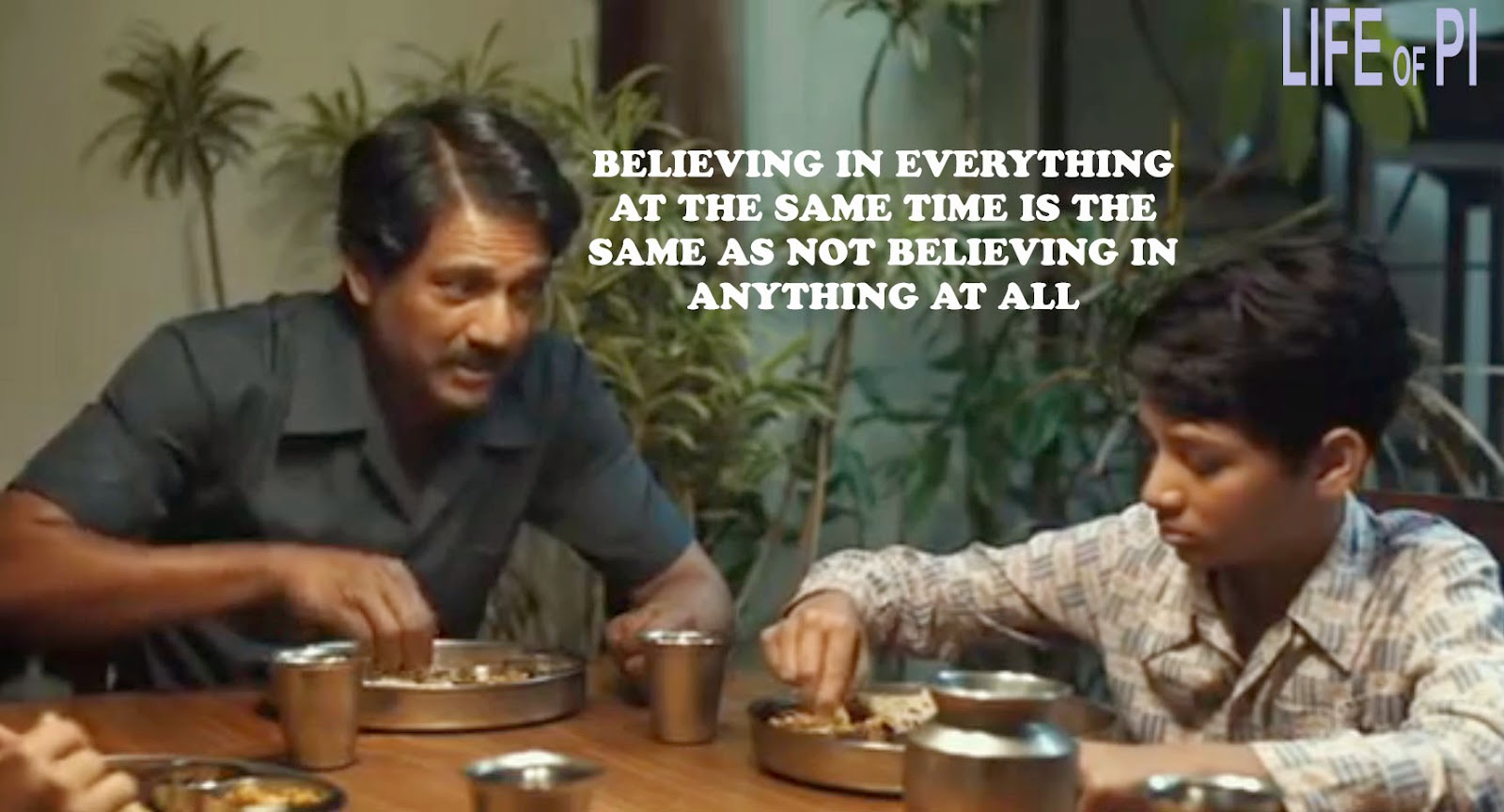
Life of Pi (Quote 4)

Spoiler alert: Pi is a raised in a predominantly Hindu family.
However, this quote / line is universal across religions, ethnicities, & races (for believers in a higher power).


IMDB          RottenTomatoes          Wikipedia

Thursday, May 7, 2015

Life of Pi (quote 1)

A great line, especially for those people who say that we don't believe in any one religion but we are spiritual, or we believe in all religions.

IMDB          RottenTomatoes          Wikipedia

Wednesday, April 15, 2015

Space for Faith: Accomodating religion on campus

I went through this problem for almost 10 years in high school & universities. Apparently, it is still a huge issue, depending on the university.
 
My view is that universities should dedicate a fairly large-sized room for quite meditation purposes. This way, student organizations can book this room for their purposes whenever they want. There's no need to dedicate a separate room for Muslim students, because, then, of course, students of other faiths have the right to ask for their own prayer rooms. Of course, if students of a particular faith really want their own room, they can always collect funds & lease the room from the university.
--------------------------------------------------------------------------------
Last October, the McGill student newspaper published a photo essay of Muslim students praying under staircases, in storage rooms & in empty classrooms.

 
It wasn’t always this way. Muslim students had a dedicated prayer room until May 2005, when the university told them they could no longer use it. A lengthy conflict between the university’s Muslim Students Association (MSA) & McGill ensued. The students filed a discrimination complaint to the Quebec human rights commission. McGill argued it wasn’t required to offer dedicated space because it is a secular institution. The commission dismissed the complaint, & the Muslim students never got their room back.
 
Dozens of Canadian universities have dedicated Muslim prayer rooms, while others don’t engage with the issue at all. In a rare move, the University of Regina recently installed special sinks for Muslim students to use before prayer. But what works at one university might lead to tension at another.
 
Last November, the entire team of Catholic chaplains at Western University quit the university’s Chaplains Association, protesting the university’s decision to provide Muslim students with a new & bigger prayer room after the old multi-faith space, which included an area designated for Muslim prayer, was closed for renovations.

What the university has created is a large space exclusively for the Muslim community, & a small room for the other faiths,” says Rev. Michael Bechard, who still leads the group of Catholic chaplains at Western’s King’s College. “I’ve been at Western since 2000, & twice a year we’ve been asking for more space,” Bechard says. “My issue is not with Islam or accommodation with the Muslim community. My issue is that, in accommodating them, it’s being done in such a way that ostracizes everyone else. It’s simply not fair.”

Then, in early January 2015, Rev. Michael Wagenman, a Christian Reformed chaplain at Western, resigned as coordinator of all university chaplains. Still a chaplain with an office in the multi-faith area, he says he speaks to students every day who are “bewildered this group is getting special treatment.” “Shared multi-faith space should be the first priority, not dedicated space,” he says.
 
But Western sees things differently. Susan Grindrod, associate vice-president of Western’s housing & ancillary services, says she’s not aware of requests for more space from other religious student groups. “We did not want to take space away from one group,” she says. “We have a large number of Muslim students . . . & this is a group that came forward & we tried to meet their needs.” She says other religious groups are welcome to book more space in addition to their multi-faith space.
 
The University of Toronto’s approach to religion on campus lies somewhere between McGill’s & Western’s. While U of T has a multi-faith centre, a building with several rooms in which weekly discussions on faith & religious diversity take place, U of T does not provide designated space for any religious group. There are several multi-purpose spaces around campus that student groups, including religious ones, are responsible for booking. “We don’t expect students to park their faith at the edge of campus,” says Richard Chambers, director of the university’s multi-faith centre. “But we don’t privilege any particular group . . . that wouldn’t fly here.” Chambers has yet to receive a request from a single religious group asking for more space.